
Seven Decades in Motion
حمولة سبعة عقود
(1939–2003)
Seven Decades in Motion is an ongoing series of installations and archival research following movement, transport labour, displacement, and memory between Palestine and the Arab Gulf through seven decades, seven trucks, and seven family figures connected through driving, trade, witnessing, and memory keeping.
Built from recorded conversations with family members, VHS and Hi8 recordings, cassette tapes, photographs, maps, and mechanical fragments, the project traces how roads gradually became part of everyday life across multiple generations of the Sharif Al-Saleh Isleem family. Moving between immersive installations and archival display, the work approaches transport not simply as movement between places, but as a continuous condition shaped by labour, migration, political rupture, waiting, and survival.
Each installation fragment is connected to a specific truck, historical phase, psychological condition, and part of the family archive. Through mirrors, desert routes, interrupted recordings, mechanical repetition, and fragmented landscapes, image and sound continuously drift between presence and disappearance.
The archive itself remains incomplete and continuously evolving through ongoing research, digitization, preservation, route reconstruction, and material studies.
As both granddaughter and a new carrier of the archive, my role within the project moves between reconstruction, listening, preservation, and continuation.
The Seven Phases
I
1939–1948
War Mobility

This phase follows Sharif Al-Saleh Isleem beginning work as a young driver during the British Mandate period after obtaining his driving license in 1939. He worked as a supply driver connected to British military routes during World War II.
Driver: Sharif Al-Saleh Isleem (c.1918–1990)
Vehicle: British Army Supply Truck
Archival material: 🎙️ Recorded conversation

Palestine Railways — Breakdown & W.D. 10 Ton Open Truck
Archival image of an early cargo transport vehicle operating in Palestine during the British Mandate period.
Resource:
The National Archives (UK) — Palestine Railways Archive.
II
1949–1959
Reconstruction

After returning to Salfit following the Nakba period, Sharif Al-Saleh Isleem rebuilt his transport work through small vehicles and later a Dodge cargo truck, gradually restoring trade and movement.
Driver: Sharif Al-Saleh Isleem (c.1918–1990)
Vehicle: Dodge Cargo Truck
Archival material: 🎙️Recorded conversation

.
III
1960–1967
Open Routes

This phase follows seasonal agricultural transport routes between Palestine and Lebanon. Produce travelled from the Jordan Valley, Jenin, Tubas, and surrounding areas toward Beirut and Lebanese markets, while fruit and goods returned through the same roads.
Driver: Sharif Al-Saleh Isleem (c.1918–1990)
Vehicle: Mercedes-Benz Cargo Truck (1959)
24-rim standard model
Archival material:
🎙️ Recorded conversation
🖼️ Family photographs
🎥 Family video archive
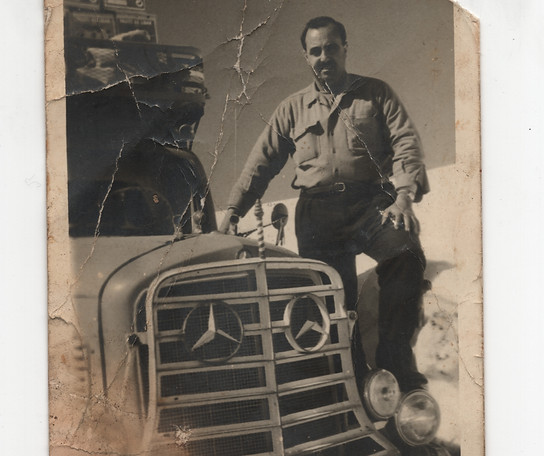
My grandfather, Sharif Al-Saleh Isleem, beside his Mercedes-Benz cargo truck, Lebanon, 1962.The truck operated on seasonal agricultural transport routes between Palestine and Lebanon during the early 1960s.
Source: Family photo album archive.
IV
1967–1973
Rupture

A newly purchased Mercedes-Benz “flat-nose” truck arrived shortly before the 1967 war. The outbreak of war interrupted movement, closed transport routes, and marked a major rupture in the family’s transport history.
Driver: Sharif Al-Saleh Isleem (c.1918–1990)
Vehicle: Mercedes-Benz “Flat-Nose” Truck
Archival material: 🎙️ Recorded conversation
.
V
1964–1973
Desert Extraction

This phase follows Saleh Sharif Al-Saleh Isleem working in Kuwait during the early years of Gulf urban expansion. Using a Chevrolet pickup, he transported gravel from desert areas to construction sites during the rapid development of the country.
Driver: Saleh Sharif Al-Saleh Isleem (1945–2003)
Vehicle: Chevrolet Pickup (1966)
Archival material:
🎙️ Recorded conversation
🖼️ Family photographs
🎥 Family video archive

Saleh Sharif Al-Saleh Isleem beside his Chevrolet pickup truck in Kuwait during the early years of Gulf urban expansion and desert transport work, late 1960s.
VI
1974–1990s
Expansion

Transport work expanded toward the United Arab Emirates through dump trucks and trailer systems connected to construction and long-distance transport labour across Gulf routes.
Driver: Nabil Sharif Al-Saleh Isleem (1952–1998)
Vehicle: Dump Truck / Trailer Trucks
Archival material:
🖼️ Family photographs
🎥 Family video archive
📼 Cassette audio recordings
🎙️ Recorded conversation
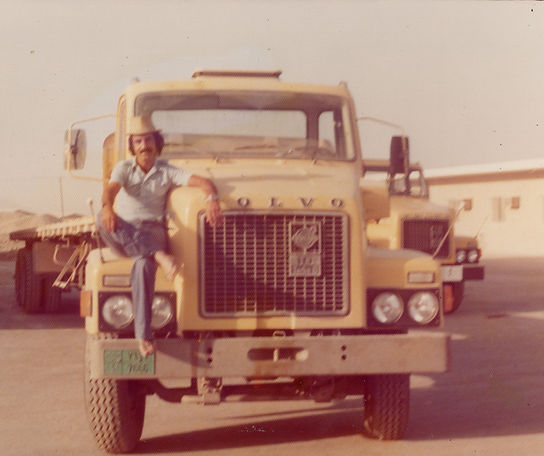
Nabil Sharif Al-Saleh Isleem sitting on his Volvo trailer truck in Abu Dhabi, United Arab Emirates, during his transport work across Gulf routes in the late 1970s–1980s.
Source: Family photo album.
VII
1990s–2003
Terminal Motion

The final phase follows the continuation of transport labour in the Gulf through Saleh Sharif Al-Saleh Isleem, who first worked as a driver for transport companies before later purchasing his own truck in the United Arab Emirates. The phase concludes in 2003 after he suffered a heart attack while working inside his truck, marking the end of the family’s direct relationship with truck driving as a profession.
Driver: Saleh Sharif Isleem (1945–2003)
Vehicle: Mercedes-Benz Heavy Truck
Archival material:
🖼️ Family photographs
👥 Future interviews
.jpg)
Saleh Sharif Isleem beside a decorated vehicle during UAE Union Day celebrations while working for Juma Al Majid Holding Group in UAE, 1989. The vehicle carries the phrase “18 Years of Progress” above the company emblem.
Source: Family photo album.
Research Structure
The project develops through multiple interconnected research layers combining family archives, transport histories, mechanical studies, oral narratives, sound research, and spatial experimentation.
Rather than approaching the archive as fixed historical material, the project treats research itself as an evolving landscape where routes, objects, documents, and memories continuously shift between personal history and larger political and infrastructural systems.
Each layer contributes to the development of the installation’s visual, sonic, and sculptural language.

Family Archives
Recorded conversation
Recorded conversation conducted by Hiba G. Isleem with Hani Sharif Isleem in Salfit, Palestine, on March 16, 2025.
Duration: approximately 1 hour and 15 minutes.
The interview traces the transport history of the Sharif Al-Saleh family from the late 1930s until 2003, including truck models, trade routes, labour migration, and personal memories involving Sharif Al-Saleh Isleem and later generations of drivers working across Palestine and the Arab Gulf.
Audio excerpt from an oral history interview with Hani Sharif Isleem describing how Sharif Al-Saleh Isleem began working as a driver in Jaffa in 1939 during the British Mandate period.
Cassette Recordings Archive
Approximately 9 family cassette recordings from the 1970s–1990s recorded by Yousef Sharif Isleem during long-distance phone calls between Abu Dhabi and Palestine. The recordings document conversations related to transport work, trade, construction, migration, and everyday family communication across distance.
Audio excerpt from a cassette recording of a long-distance phone conversation between Nabil Sharif Al-Saleh Isleem in Abu Dhabi and his father Sharif Al-Saleh Isleem in Salfit, Palestine, circa 1976. In the recording, Nabil speaks about purchasing a trailer truck and reassures his father about his work and situation in the UAE.
VHS and Hi8 Video Archive
Family VHS and Hi8 recordings filmed primarily by Yousef Sharif Isleem across Palestine and the Gulf region during the 1980s–2000s.
The recordings include Sharif Al-Saleh Isleem and Saleh Sharif Al-Saleh Isleem recounting stories from the roads, labour experiences, border crossings, and incidents that occurred during their transport journeys
An archival video recorded during a family gathering in the UAE in 1990, in which the grandfather recalls what he witnessed while driving trucks during the 1973 war, describing shells falling near the roads in the Plain of Marj Ibn Amer (Jezreel Valley) and the explosions that tore through the asphalt and blocked the roads.
Family Photographs Archive
The archive includes selected family photographs documenting Sharif Al-Saleh Isleem and later generations of drivers beside their trucks during different phases of transport work across Palestine and the Arab Gulf. The photographs capture vehicles, roads, trade routes, work environments, family gatherings, migration, and everyday moments connected to movement and labour from the 1950s onward.

Family photographs mailed from the United Arab Emirates to Palestine, with handwritten notes preserved on the back of the prints. The images trace personal connections, distance, and communication between family members across borders. Source: Saleh Collection.

Personal photograph of Saleh Isleem inside a truck cabin in Kuwait during the 1970s. The interior ceiling of the truck appears in the image, reflecting the atmosphere and working environment of long-distance transport during that period. Source: Saleh Collection.

Family photographs mailed from the United Arab Emirates to Palestine, with handwritten notes preserved on the back of the prints. The images trace personal connections, distance, and communication between family members across borders. Source: Saleh Collection.
A selection of photographs from the archive of Saleh Sharif Isleem, centered around trucks, transport work, travel routes, and everyday life in the Gulf, alongside personal family photographs preserved in the family albums.
Source: Saleh Sharif Isleem Collection
Digitization & Preservation
The project archive is currently undergoing an ongoing digitization and preservation process involving VHS, Hi8, cassette recordings, photographs, and printed materials collected from the Sharif Al-Saleh Isleem family archive.The process includes scanning, audio restoration, noise reduction, transcription, cataloguing, metadata organization, and long-term archival storage preparation to preserve the materials for future access and research.
One of the current challenges involves the rarity and instability of older playback technologies, particularly Hi8 PAL video systems, cassette readers, and analogue transfer equipment, which are increasingly difficult to access or maintain in stable archival conditions.

Digitization and preservation setup during the ongoing archival transfer process at Akademie Schloss Solitude, Stuttgart, 2025. The image documents part of the working environment used for digitizing Hi8 video tapes, cassette recordings, and analogue archival materials from the Sharif Al-Saleh Isleem family archive.
Materials & Fragments
This section focuses on fragmented vehicle details and material traces collected throughout the research process for Seven Decades in Motion. Through mirrors, dashboards, cassette players, steering wheels, truck interiors, mechanical objects, and damaged archival surfaces, the project approaches transport history through partial memories and material remains.


The materials are collected from family photographs, vehicle archives, and transport-related visual fragments connected to movement across Palestine and the Arab Gulf.
Vehicle & Mechanical Research
This research layer focuses on truck models, transport mechanics, vehicle interiors, manuals, repair cultures, and material fragments connected to transport work across different historical phases of the project. The research includes family vehicle histories alongside ongoing communication with companies and archives related to Mercedes-Benz in Stuttgart, as well as future research connected to Volvo, Chevrolet, and other transport manufacturers linked to the family’s transport history.
Current Research and Installation Development
Mirage Route
INTERMIX Residency — Riyadh, Saudi Arabia
Visual Arts Commission
10 May 2026 — 02 August 2026
The current phase of Seven Decades in Motion, titled Mirage Route, is being developed during the INTERMIX Residency in Riyadh. Alongside the installation development, the research expands the project's archival and historical framework through recorded conversations with family members, route reconstruction, family records, maps, photographs, and transport histories connected to migration between Palestine and the Arab Gulf following the 1967 Naksa.
Drawing from family journeys through Saudi Arabia toward Kuwait and the United Arab Emirates, the installation examines distance, waiting, labour, uncertainty, and the persistent feeling of travelling toward an unknown destination. Through moving image, sound, vibration, reflection, and a truck side mirror overlooking an endless desert road, memories emerge as fleeting mirages before dissolving back into the landscape.
Research Dossier